STUDIO BUSINESS / FREE PLANNING RESOURCE
Studio Rental Checklist & Quote Comparison Worksheet
A lower hourly rate can produce a higher final bill. Compare the same activity, time window, included equipment, and mandatory charges before choosing a photography, dance, or yoga space.
A studio comparison worksheet you can actually use
Start with one brief: the activity, date, number of people, and total time needed including setup and cleanup. Send that same brief to each operator. A quote for a two-hour shoot is not comparable to a four-hour event, and a teaching business may not rent its room to outside instructors.
The worksheet provides three quote columns and a source/confirmation column. It leaves operator answers blank instead of supplying invented local prices. The checklist below can be ticked on this page and printed; it is not a booking request and does not submit information to Circular Studios.
The questions and worked example are original editorial guidance. They are not a building inspection, insurance recommendation, accessibility certification, or legal checklist. The operator and the applicable authorities must confirm requirements for the actual use.
Why the cheapest hourly rate can cost more
Suppose you need three booked hours, including setup and cleanup. Quote A is $60/hour with a four-hour minimum and a mandatory $40 cleaning fee. Quote B is $80/hour with a three-hour minimum and no mandatory additional charge in this example. Assume both venues permit the same activity and include the same equipment.
Quote A: $60 x 4 + $40 = $280. Quote B: $80 x 3 = $240. The higher headline rate produces a $40 lower total for this brief. These are invented examples to show the arithmetic, not observed venue rates or a claim about national rental prices.
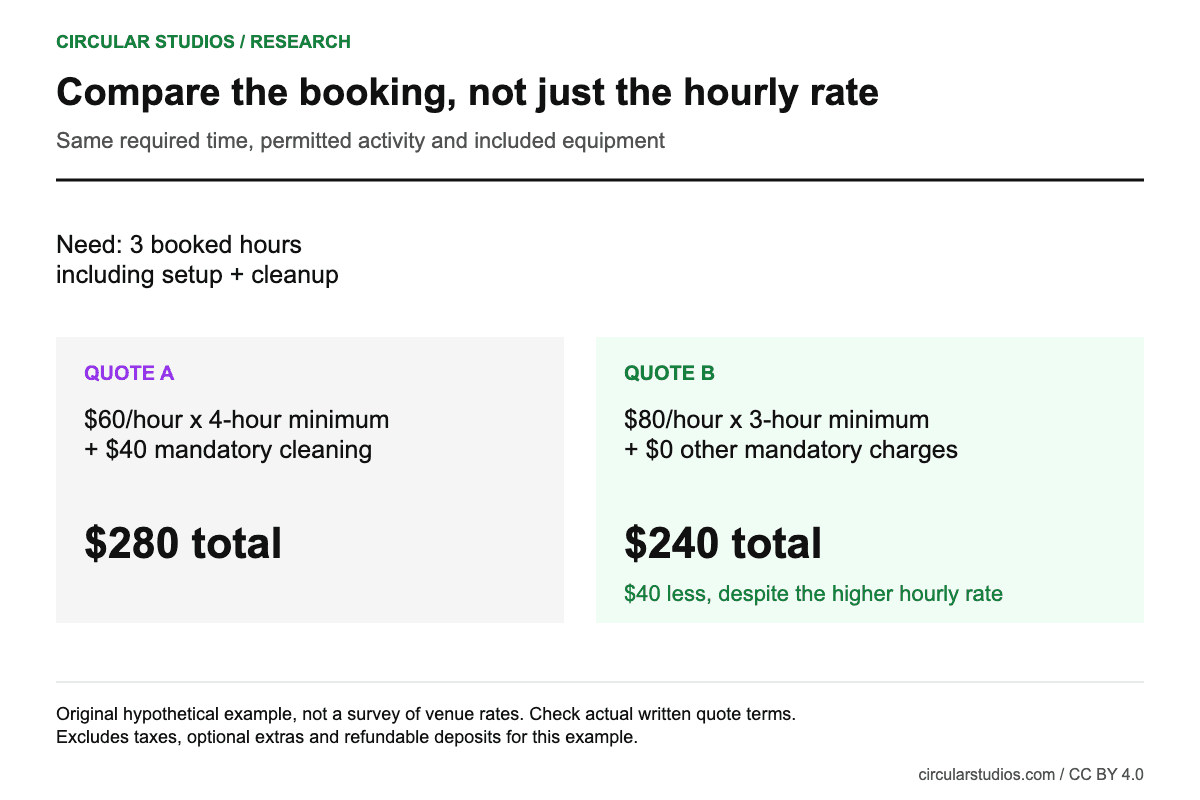
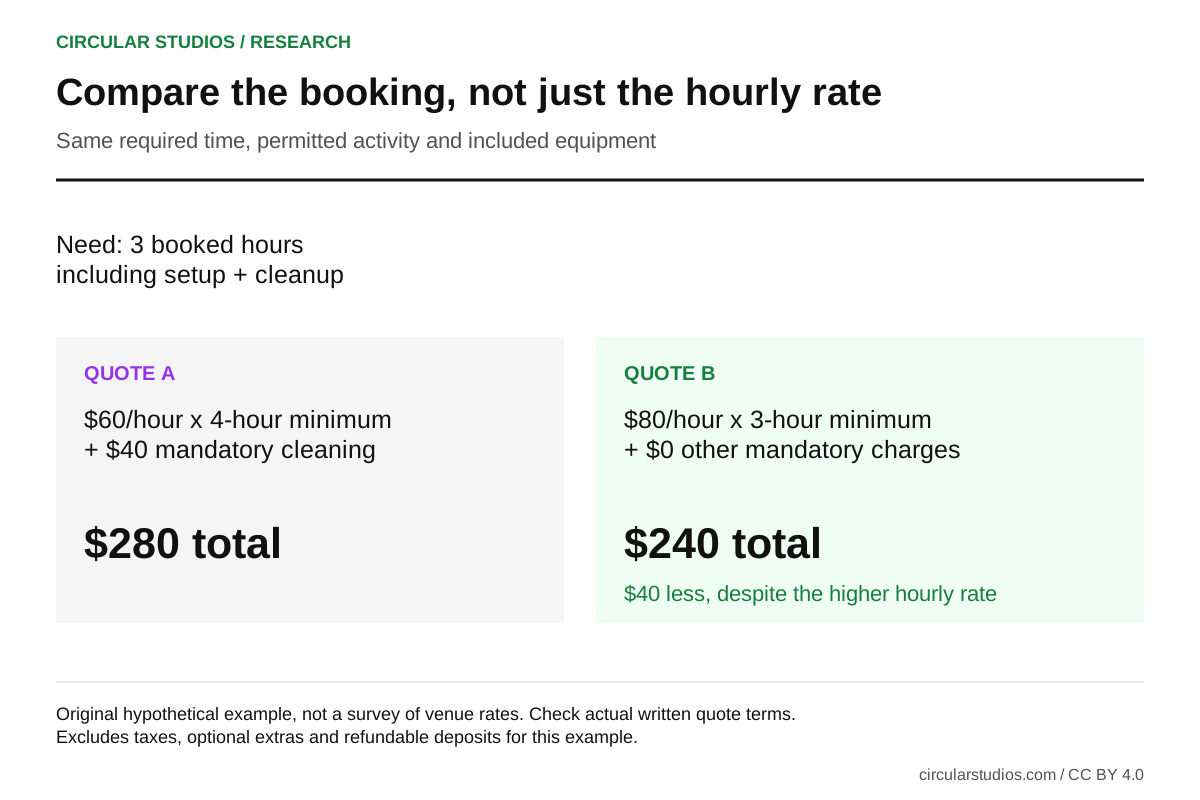
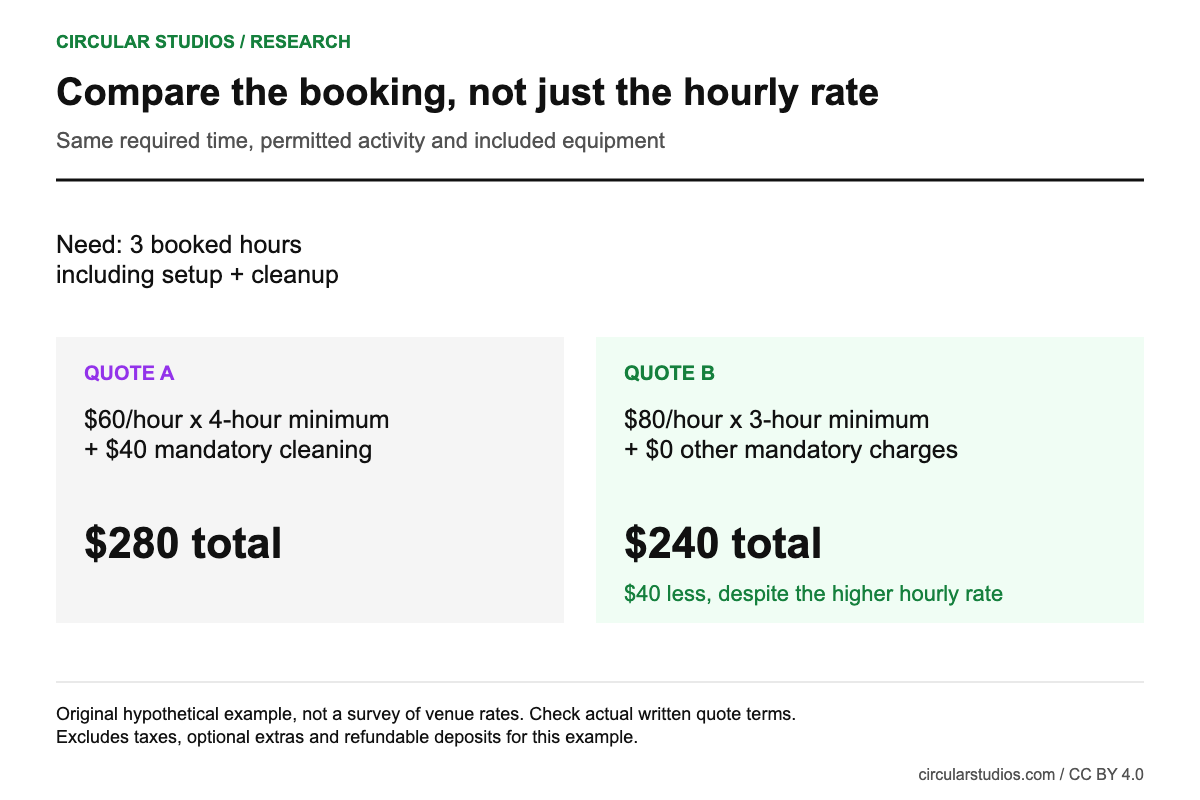
The planning formula is required rental charge = hourly rate x max(required booked hours, minimum billed hours), plus quoted mandatory charges. A venue may use packages, billing increments, peak rates, per-person fees, or other terms, so its actual written quote takes precedence over this simplified formula.
A refundable deposit affects cash needed at booking even if it is not ultimately a rental expense. Keep it separate from the nonrefundable total, and record the conditions and timing for its return. Do the same for taxes and optional extras: an excluded amount is not necessarily zero.
If the additional billed hour in Quote A is useful to you, that can change the decision. Compare the complete offer, not only the total. A venue with the right floor, load-in access, or quiet recording conditions may be worth more than a cheaper space that cannot support the activity.
Studio rental checklist: ten things to confirm
Confirm outside bookings, permitted activity, available room, date and time. A photography business, dance school, or yoga studio is not automatically a rental venue.
Record arrival, equipment load-in, rehearsal or shooting time, reset and departure. Ask when billing begins and how overtime is calculated.
Record rate unit, minimum booking, mandatory charges, tax treatment, included equipment, staffing and refundable deposit separately. Ask for a written quote for the same activity and duration.
Ask the operator for permitted use and applicable occupancy limits for your event. Do not derive a legal capacity from floor area or a directory photograph.
Confirm usable dimensions, ceiling height, obstructions, floor type, ventilation, light control, sound conditions and equipment. A room's total square footage may include non-usable areas.
Ask about step-free access, door and lift dimensions, accessible facilities, parking, public transport and loading. Avoid assuming accessibility from an address or listing photo.
List what is included, what needs a separate rental, whether an operator is required, and how damage or missing equipment is handled. Confirm permission before attaching or moving anything.
Verify amplified music, vibration, recording noise, blackout needs, power limits, neighboring uses, smoking or special effects, and any building time restrictions relevant to your plan.
Record payment deadlines, rescheduling, cancellation windows, refund terms, overtime charges, damage-deposit timing and any stated insurance requirements. Clarify ambiguity before paying.
Save the quote, the operator's contact, and when the terms were confirmed. Mark missing answers as unknown rather than no. Reconfirm material details before the booking.
Ticking a box records your review, not certification that a venue meets a standard. Save the written evidence behind each material answer. The page does not store your selections after refresh.
What changes for photography, dance and yoga?
Photography and video
Ask about usable shooting dimensions, ceiling height, natural-light direction and timing, blackout options, backdrops, power, changing areas, and the exact lighting and grip equipment included. For recording, confirm sound conditions at the intended time rather than treating a photography rental as a soundproof stage. Verify load-in access for your actual equipment cases.
Our photography directory lists businesses, not only rentable spaces. Contact the operator to distinguish a photography service from a venue accepting independent bookings. Published photos can help identify questions to ask; they cannot establish the current equipment inventory or room condition.
Dance classes and rehearsals
Confirm floor type and condition, permitted footwear, usable movement area, mirrors and barres if needed, sound-system availability, music restrictions, and whether a rehearsal or teaching use is permitted. Do not infer suitability for a dance style from the venue name. Check access time and changeover rules if another class immediately precedes or follows your booking.
The dance directory can help identify local schools and spaces to contact, but instructional availability and rental availability are separate facts. The dance participation statistics describe national activities, not the number of rooms available in your city.
Yoga instruction and workshops
Ask about the room layout, ventilation and temperature arrangements, noise, props, mat storage, cleaning responsibilities, accessible facilities, and any limitations on outside teaching. A venue's class format does not establish that another instructor can hire it. Confirm how much time is needed to set up, welcome participants, and leave the room ready for its next use.
Start with the yoga directory, then check the current offer directly. National yoga participation data include independent practice as well as classes; they cannot establish demand for a specific rented workshop.
Handle unknown details without guessing
Use three states in your comparison: confirmed, not offered, and unknown. A missing accessibility description is not proof of inaccessibility. An omitted fee is not proof that no fee applies. A missing rental link is not proof that a school accepts outside bookings. Ask for the evidence, record the answer, and keep uncertainty visible.
For recurring teaching or rental commitments, translate the confirmed quote into a monthly scenario only after defining booking frequency and cancellations. Then use the studio break-even calculator to test the sales needed to cover your entered costs. It cannot validate the venue's terms or predict enrollment.
Owners can make comparisons easier by keeping their own public location and phone information correct and explaining the services they actually offer. Claim or list a studio through the existing review flow. A free listing does not certify a venue's suitability, and a sponsored placement does not replace checking the quote.
Reuse this resource
The worksheet, worked examples, and original graphics are free to reuse. Our original analysis and graphics use CC BY 4.0. Credit Circular Studios and identify any changes. Federal source data remain public domain; we do not claim to have conducted the surveys.
Circular Studios. (October 3, 2026). Studio Rental Checklist & Quote Comparison Worksheet. https://circularstudios.com/research/studio-rental-checklist. Original planning resource; example inputs are illustrative.
For a correction, missing source detail, or a question about reuse, contact Circular Studios. We check the evidence before updating a number; the date above records this release, not a claim that the underlying data were collected in 2026.
Sources and editorial notes
- SBA: Market research and competitive analysis. Background for comparing a defined service and market. The checklist, scenarios and worked quote example are original editorial tools, not an SBA-approved rental standard.
Primary sources checked for this release. Survey findings, our calculations, and illustrative operating assumptions are labeled separately. Paid placements do not determine these findings or the selection of sources.
More studio research and planning resources
Take the comparison local
National research cannot establish what a particular neighborhood needs or whether a venue has space available. Use a city directory to identify operators, then confirm current services, pricing, access, and booking terms directly.
Browse photography, dance, and yoga. Coverage is our directory inventory, not a national census.
Own a studio? List or claim your space for a free name, address, and phone listing, reviewed by our admin. A paid full listing can include your website and social links; Featured remains $49/month or $399/year. Publishing this research does not imply any venue endorsement.