STUDIO BUSINESS / FREE PLANNING RESOURCE
Studio Break-Even Calculator: Rental Hours & Class Visits
A studio breaks even when paid sales cover the costs entered in its operating model. Calculate the rental hours or class visits required, then check whether your monthly capacity can actually accommodate them. The examples are illustrative assumptions, not average prices or a revenue forecast.
Calculate monthly studio break-even
Illustrative starting inputs, not average studio costs or prices. A class visit is one paid attendance, not one unique student. All costs and capacity use the same month.
Whole paid rental hours to cover costs
60
50.0% of available capacity at $75 contribution per rental hour.
- Continuous break-even
- 60 paid rental hours
- Break-even revenue
- $5,400
- Projected monthly operating result
- $1,500
- At full available capacity
- $4,500
Capacity can accommodate this break-even volume. Demand is not assumed or guaranteed.
| Capacity used | Paid hours | Revenue | Operating result |
|---|---|---|---|
| 25% | 30 | $2,700 | -$2,250 |
| 50% | 60 | $5,400 | $0 |
| 75% | 90 | $8,100 | $2,250 |
| 100% | 120 | $10,800 | $4,500 |
Operating result only includes entered costs. Include owner compensation if it needs to be covered; taxes, financing cash flows, deposits, and startup spending need separate treatment. Inputs stay in this page and are not submitted or saved.
The studio break-even formula
Break-even units = monthly fixed costs / (realized price per unit - variable cost per unit). This is the single-service contribution model described by the U.S. Small Business Administration. We adapt the units to a studio and add an explicit capacity check.
- Contribution per unit
- Realized price minus the cost that increases with that sale. It is the amount available to cover fixed costs, not net profit.
- Break-even utilization
- Break-even units divided by available monthly units, multiplied by 100. More than 100% means the entered capacity cannot cover the entered costs at that price.
- Projected operating result
- Projected sold units multiplied by contribution, minus fixed costs. It only covers the expenses you entered.
- Whole units to cover costs
- The continuous result rounded upward. Actual rental billing increments can differ; a class visit is one paid attendance, not a unique member.
Use a consistent unit and period. A rental model should use paid room-hours, an hourly realized price, and per-hour variable costs. A group-class model here uses paid visits, realized revenue per visit, and per-visit variable costs. Do not put a monthly membership price into a per-visit model without estimating how many paid visits that membership represents.
Available capacity is capacity you can sell, not every hour in a calendar month. Exclude setup buffers, maintenance, reserved teaching time, closed days, and unusable hours. For classes, sum the places available across scheduled classes; 20 classes with 10 places provide 200 possible visits, not 200 unique students.
Two worked studio scenarios
Photography or rehearsal-space rental
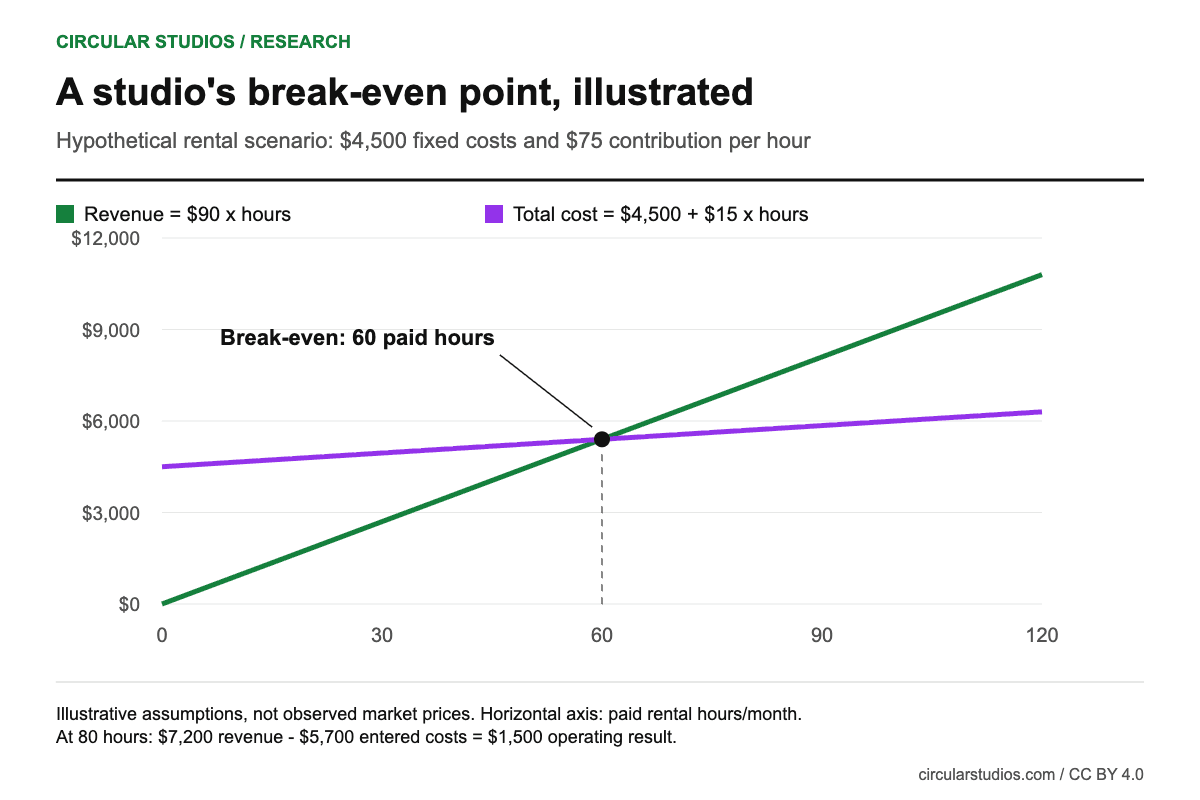
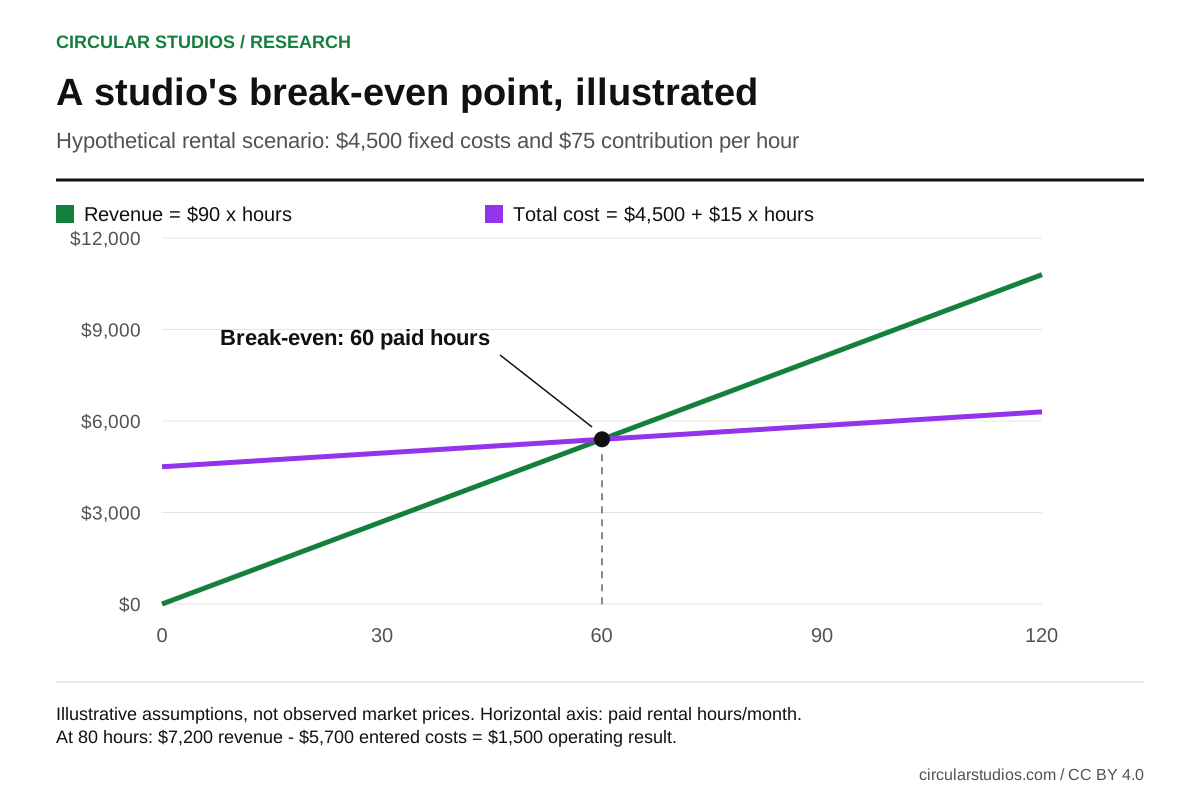
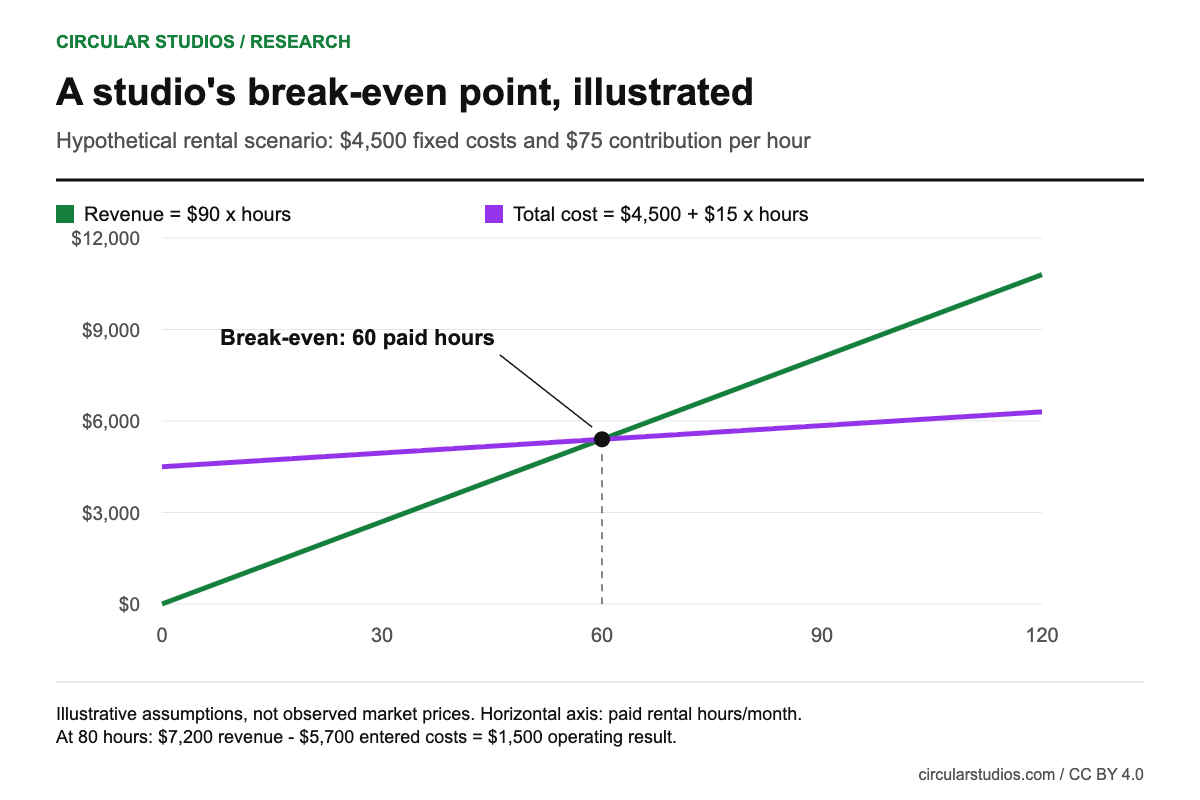
Suppose monthly fixed costs are $4,500, realized rental revenue is $90 per paid hour, and variable cost is $15 per paid hour. Contribution is $75. Break-even is $4,500 / $75 = 60 paid hours. With 120 bookable hours, that is 50% utilization. Selling 80 hours produces $7,200 in revenue and a $1,500 operating result after the entered costs.
Reducing bookable capacity to 50 hours does not change the 60-hour break-even requirement. It makes it infeasible: even full capacity would leave a $750 shortfall. A lower occupancy assumption cannot repair a capacity constraint; the offer, price, cost structure, or available capacity must change.
Yoga or dance class visits
Suppose fixed monthly costs are $6,000, realized revenue is $20 per paid class visit, and variable cost is $4 per visit. The $16 contribution gives a continuous break-even of 375 visits. At 800 available visits per month, the required utilization is 46.875%, displayed as 46.9%. Selling 400 visits produces $8,000 revenue and a $400 operating result.
If instructors are paid per class regardless of attendance, that cost is not automatically a $4 per-visit cost. Include the scheduled class payments in the monthly cost scenario, or build a more detailed class-level model. The example does not prescribe teacher compensation or assume that all studio costs vary with attendance.
Keep a dated copy of the assumptions and evidence behind them. The calculator exports your current scenario; the blank worksheet provides fields for source notes and a review date. Neither requires registration or submitting financial information to Circular Studios.
Which costs belong in a studio operating model?
The classification depends on your agreement and sales unit. Rent is often fixed for the month; payment fees may rise with transactions. Cleaning may be per booking rather than per hour. An instructor might be paid a monthly amount, per class, per attendee, or under another arrangement. Read the contract instead of assigning a cost type from its name.
| Check | How to treat it |
|---|---|
| Lease, recurring insurance and software | Include the monthly portion of recurring amounts that remain payable regardless of the entered sales volume. |
| Payment processing and consumables | Estimate the cost per consistent sales unit, including fixed transaction fees where relevant. |
| Staff, teachers and cleaning | Identify whether payment is monthly, per shift, per class, per booking, or per visit. Convert deliberately; do not count it twice. |
| Owner compensation | Include an amount if the model must cover your compensation. A positive result without it is not evidence that the owner earns a living. |
| Annual bills | Divide an annual recurring expense by 12 for a monthly planning allocation. A quarterly recurring expense is divided by 3. |
| Deposits, equipment and initial fit-out | Track startup funding and cash timing separately. Refundable deposits are not automatically an operating expense; accounting treatment depends on the item. |
If a room also generates memberships, events, equipment hire, or photography services, a single realized hourly price may hide the economics. Use a detailed model with separate revenue streams and avoid assigning the same fixed cost in full to every stream. The photography business report also explains why gross business receipts are not owner income.
What this calculator cannot predict
The calculator does not forecast demand, retention, seasonality, cancellations, collections, refunds, taxes, loan principal, or cash availability. It assumes a constant realized price and variable cost per unit over the tested volume. A staffing step change, higher peak-hour rate, or membership mix can violate that simplification.
Break-even volume is a requirement, not a forecast. The yoga participation data and dance participation data cannot establish your local conversion rate. Validate an offer through local customer and operator research, then compare realistic low, expected, and high scenarios.
For a rental comparison, use the studio rental checklist and quote worksheet before choosing the headline hourly rate. Confirm mandatory fees and minimum durations with the venue. For budgeting, financing, or tax decisions, review the full model with an appropriately qualified adviser; this free tool is an operating illustration, not individualized financial advice.
Reuse this resource
The worksheet, worked examples, and original graphics are free to reuse. Our original analysis and graphics use CC BY 4.0. Credit Circular Studios and identify any changes. Federal source data remain public domain; we do not claim to have conducted the surveys.
Circular Studios. (October 3, 2026). Studio Break-Even Calculator: Rental Hours & Class Visits. https://circularstudios.com/research/studio-break-even-calculator. Original planning resource; example inputs are illustrative.
For a correction, missing source detail, or a question about reuse, contact Circular Studios. We check the evidence before updating a number; the date above records this release, not a claim that the underlying data were collected in 2026.
Sources and editorial notes
- SBA: Break-even point. Single-service formula: fixed costs divided by price minus variable cost per unit. Our tool adds an explicit capacity check; example inputs are not market data.
- SBA: Plan your business and startup costs. Distinguish startup spending, ongoing monthly costs, and market research. This simplified calculator is not accounting or financing advice.
Primary sources checked for this release. Survey findings, our calculations, and illustrative operating assumptions are labeled separately. Paid placements do not determine these findings or the selection of sources.
More studio research and planning resources
Take the comparison local
National research cannot establish what a particular neighborhood needs or whether a venue has space available. Use a city directory to identify operators, then confirm current services, pricing, access, and booking terms directly.
Browse photography, dance, and yoga. Coverage is our directory inventory, not a national census.
Own a studio? List or claim your space for a free name, address, and phone listing, reviewed by our admin. A paid full listing can include your website and social links; Featured remains $49/month or $399/year. Publishing this research does not imply any venue endorsement.